

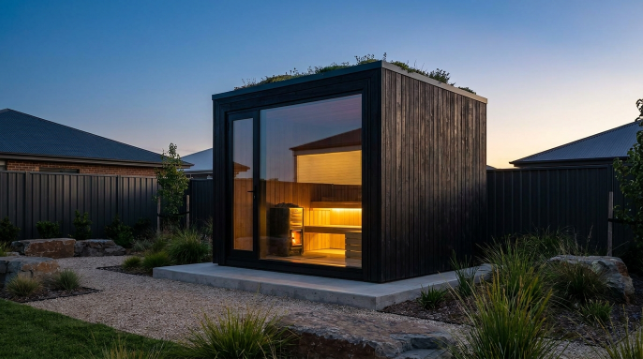
When a yard cannot fit a four-person cube sauna, the realistic options are a smaller two-person cube, a compact corner-fit cabin, or an indoor infrared unit, each of which delivers most of the same regular-use benefits without the larger footprint. A two-person cube commonly needs roughly a five-by-five-foot pad, runs on a smaller heater, and costs less to operate per session. The health research behind sauna use tracks how often and how long people sit in the heat, not how many people fit on the bench, so a smaller cabin used consistently is not a lesser choice, just a different-sized one.
How Small Can an Outdoor Cube Sauna Actually Get?
Most manufacturers offer a two-person cube as their entry size, and the footprint is meaningfully smaller than the four-person version, often close to five feet by five feet rather than six or seven feet per side. That difference matters more than it sounds like on paper, since it is frequently the gap between a cabin that fits in a side yard or a corner of a patio and one that simply does not fit anywhere on the lot. A two-person cube keeps the same glass-front design language as its larger siblings, so buyers are not sacrificing the aesthetic that drew them to the cube style in the first place, only the seating count and a few square feet of interior room.
What Does a Smaller Cube Sauna Save on the Electrical Side?
Heater size scales down with cabin volume, and that has a real effect on both installation cost and ongoing electric bills. A two-person cabin typically pairs with a heater in the 4.5 to 6 kilowatt range, compared with roughly 6 to 9 kilowatts for a four-person model, and the smaller draw sometimes means an easier, cheaper electrical run depending on how far the unit sits from the panel. Running costs follow the same pattern: a smaller heater working to hold a smaller volume of air at temperature simply pulls less power per session, which adds up over a year of regular use. None of this changes the core electrical requirement, most sauna heaters above roughly 4 kilowatts still need a dedicated 240-volt circuit, so a smaller cabin reduces the size of that project rather than eliminating it.
Is an Indoor Infrared Cabin a Real Alternative?
For households with no usable outdoor space at all, an indoor infrared cabin solves a different problem than a smaller cube does. Infrared units heat the body more directly at a lower ambient air temperature, generally 120 to 150 degrees Fahrenheit versus 150 to 195 for a traditional electric sauna, and many models run on a standard 120-volt household outlet rather than requiring dedicated 240-volt wiring. That makes an infrared cabin genuinely easier to add to a basement, garage, or spare room without an electrician’s involvement in many cases. What it does not replicate is the steam-capable, higher-heat experience that draws most people to an outdoor cube sauna in the first place. Buyers who specifically want that traditional heat and have any usable outdoor corner at all are usually better served comparing smaller cube and barrel options before defaulting to infrared purely for space reasons.
What Do the Health Associations Actually Depend On?
This is the detail that matters most for anyone assuming a smaller sauna is a lesser one health-wise. The research behind sauna bathing and cardiovascular associations is built around frequency and session duration, how many times a week someone sauna bathes and for how long, not cabin size or how many people fit on the bench at once. A widely cited Finnish cohort study found lower rates of fatal cardiovascular events among men who used a sauna four to seven times a week compared with once a week, and that pattern is just as achievable in a two-person cabin used consistently as in a larger one used occasionally. A 2018 review in Mayo Clinic Proceedings summarized similar associations across a range of studies, none of which distinguish cabin size as a variable. In practical terms, a smaller cube sauna used four times a week fits the studied pattern better than a larger cabin that sits unused because it never quite fit the budget or the yard.
How Should You Decide Between Downsizing and Skipping Outdoor Altogether?
Start with the actual measurements of the space under consideration, including clearance for the door to open and room to walk around at least one side for maintenance access, rather than working backward from a size you already like. If even a two-person footprint genuinely does not fit, an indoor infrared cabin is the more realistic path, and it is worth being honest about that early rather than forcing an outdoor unit into a spot that will cause problems with neighbors, setback rules, or simple day-to-day access. If a two-person footprint does fit, it is worth taking the time to compare models here against the larger four-person option, since the price difference between sizes is sometimes smaller than buyers expect relative to the space and running-cost savings.
What Should Buyers Verify Before Committing to a Smaller Cabin?
Confirm the exact footprint and required clearance from the manufacturer’s spec sheet rather than estimating from photos, since two-person models vary more between brands than the four-person category does. Ask what heater size ships with the specific model and whether it needs a dedicated circuit, since some smaller units still require 240-volt service despite the reduced footprint. Finally, check the warranty terms on both the heater and the wood structure separately, since a smaller cabin is not automatically built to a lower standard, but it is worth confirming rather than assuming.
Frequently Asked Questions
What is the smallest usable outdoor cube sauna? Two-person cube models are the smallest common size, with a footprint often close to five by five feet, fitting into corners and side yards that could never hold a four-person or six-person cabin.
Is an indoor infrared cabin a real substitute for an outdoor cube sauna? It is a different experience rather than a lesser one. Infrared cabins run at lower temperatures, heat up faster, and often plug into a standard outlet, but do not produce the same heat and steam intensity.
Do smaller saunas still provide the same health associations as larger ones? The research is based on session frequency and duration, not cabin size. A small two-person unit used regularly fits the same studied pattern as a larger cabin used the same way.
How much smaller is a two-person cube sauna’s operating cost? A two-person cube typically pairs with a smaller heater, often 4.5 to 6 kilowatts versus 6 to 9 kilowatts for a four-person model, generally lowering the electric cost per session.
References
- Does the Combination of Finnish Sauna Bathing and Other Lifestyle Factors Confer Additional Health Benefits? A Review of the Evidence, Mayo Clinic Proceedings, 2023
- Clinical Effects of Regular Dry Sauna Bathing: A Systematic Review, Evidence-Based Complementary and Alternative Medicine, 2018
- Cardiovascular and Other Health Benefits of Sauna Bathing: A Review of the Evidence, Mayo Clinic Proceedings, 2018
By Grant Whitfield